
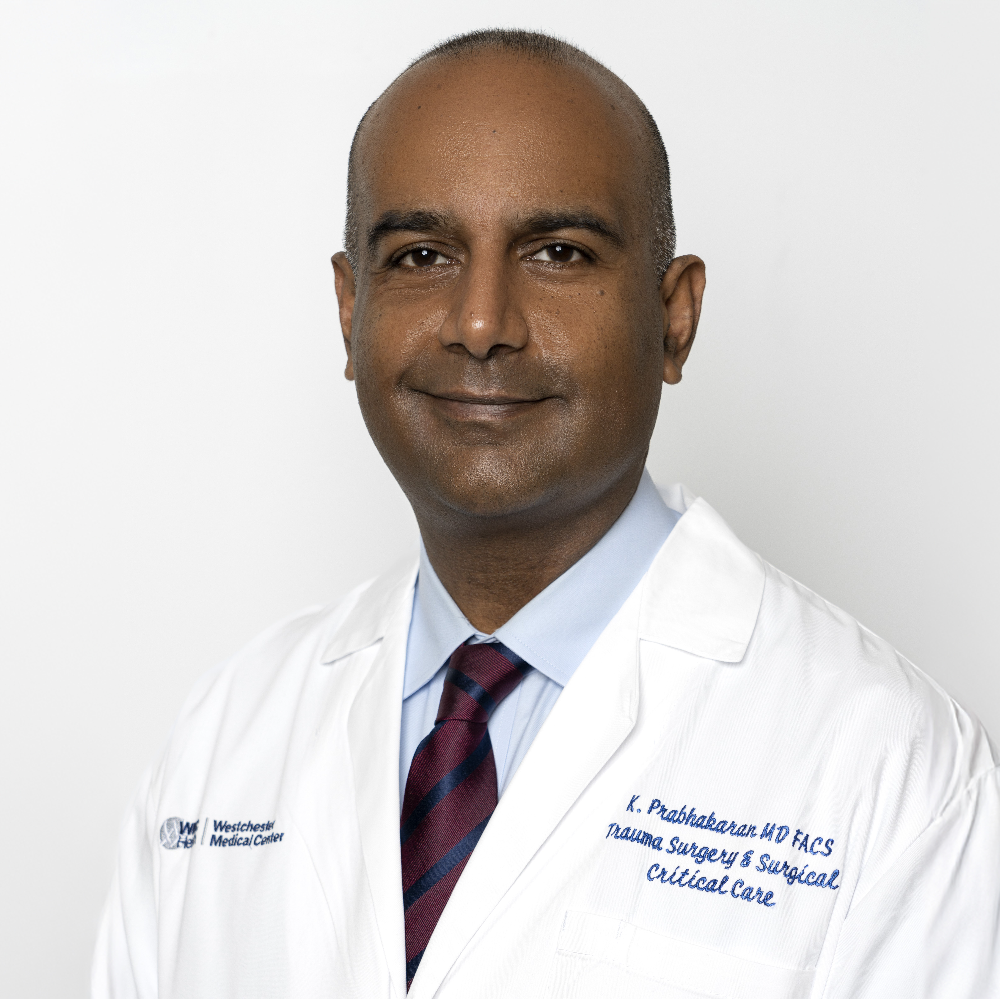
A nationally recognized trauma surgeon and academic leader, Kartik Prabhakaran, M.D., M.H.S., FACS, currently serves as chair of the Department of Surgery for the Westchester Medical Center Health (WMCHealth) Network and director of the WMCHealth Trauma Consortium. He joined the faculty of NYMC in 2014.
Dr. Prabhakaran has made extraordinary contributions to WMC and the field of trauma care. In addition to leading the only adult Level I Trauma Center between New York City and Albany, Dr. Prabhakaran has led the development of an institutional Network Trauma Consortium that has grown into an integrated system consistently achieving the highest standards of clinical excellence, academic rigor, and patient-centered innovation. Dr. Prabhakaran serves as chair of the American College of Surgeons Committee on Trauma for the Greater New York region and is a national reviewer for the American College of Surgeons’ Verification Review Committee.
In addition to his clinical leadership, Dr. Prabhakaran has served as program director for the largest Surgical Critical Care Fellowship in New York State at WMCHealth and has been a dedicated mentor to residents and medical students. He is the author of more than 90 peer-reviewed publications and book chapters and has presented his work nationally and internationally, with research interests that include traumatic brain injury, geriatric trauma, and trauma outcomes.
Education
- Fellowship, Surgical Critical Care, Weill Cornell Medicine/Lincoln Medical Center
- Residency, General Surgery, Albert Einstein College of Medicine/Montefiore Medical Center
- M.D., University of Pittsburgh School of Medicine
- M.H.S., Johns Hopkins University
Publications
- El-Qawaqzeh K, Mehta R, Grant C, et. al. "From Vulnerability to Violence: The Intersection of Social Vulnerability and School Shootings." Journal of pediatric surgery, (), (2026) 163571. doi: 10.1016/j.jpedsurg.2026.163571
- Kannichamy V, Zangbar B, Prabhakaran K, et. al. "Under the tarp: A national analysis of cost and clinical outcomes following thoracoscopic versus open rib fixation." American journal of surgery, 263(), (2026) 117299. doi: 10.1016/j.amjsurg.2026.117299
- Peisepar M, Rafieezadeh A, Prabhakaran K, et. al. "Scapular fracture and risk of great vessel injury in geriatric blunt trauma: A TQIP analysis." Injury, 57(12), (2026) 113835. doi: 10.1016/j.injury.2026.113835
- Mehta R, Zangbar B, Prabhakaran K, et. al. "Mortality Risk Across Early RBC-Equivalent Transfusion Burden in the Whole Blood Era." Journal of the American College of Surgeons, (), (2026) . doi: 10.1097/XCS.0000000000002247
- Kannichamy V, Peisepar M, Vetri R, et. al. "Airbag Deployment as a Trigger for Blunt Cardiac Injury Screening: A Nationwide Trauma Analysis." The American surgeon, (), (2026) 31348261494133. doi: 10.1177/00031348261494133
- Zangbar B, Peisepar M, Mehta R, et. al. "Rib fixation still helps: Surgical stabilization of rib fractures in traumatic brain injury, a TQIP Study." The journal of trauma and acute care surgery, (), (2026) . doi: 10.1097/TA.0000000000005171
- Zangbar B, Harikrishnan S, Mehta R, et. al. "Effect of regional anesthesia timing on clinical outcomes in isolated flail chest: A nationwide analysis." The journal of trauma and acute care surgery, (), (2026) . doi: 10.1097/TA.0000000000005114
